
Molly Gourlay: Permission, Place, and a Lifetime of Influence in Women’s Golf What Molly Gourlay’s…
Women’s Golf Is a Community of Culture
Why visibility brings people in — but culture is what makes them stay
For a long time, women’s golf has been discussed primarily in the language of participation.
Who is joining. Who is leaving.
Which pathways work. Which age groups are missing.
But history tells a different — and more useful — story.
Women’s golf did not endure for over a century because women were merely allowed to play, nor because elite role models occasionally became visible. It endured because women built and sustained a cultural world around the game — one that created identity, continuity, authority, and a place to belong across a lifetime.
That distinction matters.
From participation to belonging
When we look at women’s golf through a cultural lens, a clear pattern emerges.
Where women:
- organised competitions
- governed themselves
- mentored one another
- aged visibly within the game
- carried memory and continuity
participation became durable rather than episodic.
Where entry was offered without culture, participation proved fragile — however inspiring the moment of arrival.
Contemporary participation data now shows the same pattern in reverse.
Women’s golf as a cultural system
To make this distinction clearer, it helps to step back from individual experiences and look at women’s golf as a system rather than a set of participation moments.
The visual below shows how visibility, culture, and staying relate to one another — and why entry alone is never enough to create durable participation.
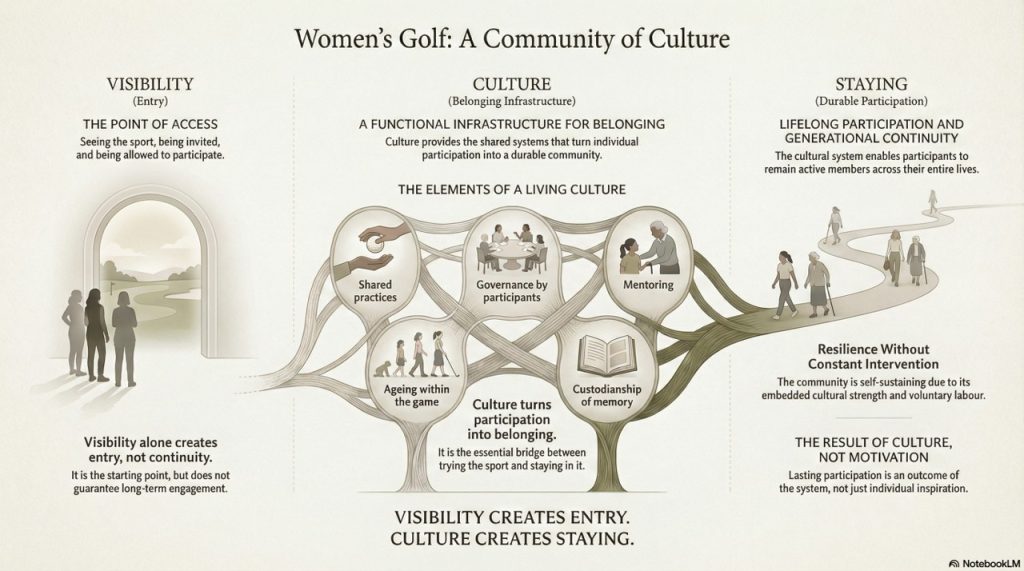
What it shows is simple but often overlooked:
- Visibility creates entry
- Culture provides the infrastructure for belonging
- Staying is the result of culture, not individual motivation
Culture, in this sense, is not atmosphere or tradition for its own sake.
It is functional infrastructure — shared practices, governance by participants, mentoring, continuity, and care.
This is why women’s golf has proven resilient even when formal systems have failed to support it.
Senior women are not retirement groups
One implication of this cultural lens is often misunderstood.
When women’s golf is viewed only as a pathway, senior women’s associations are frequently described as “retirement groups” — as if they sit at the end of participation rather than within it.
Culturally, this is a misreading.
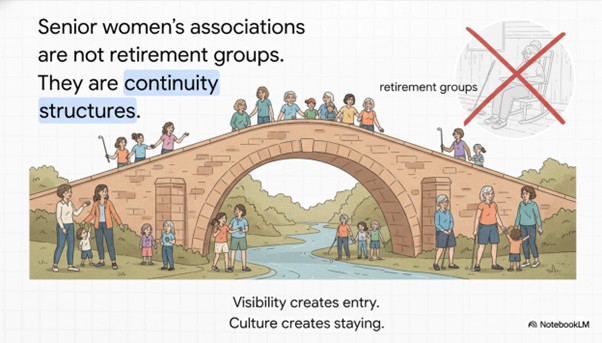
Senior women’s associations are not retirement groups.
They are continuity structures.
They carry knowledge, sustain competitions, mentor others, and hold communities together when formal pathways fall away. In cultural terms, they are infrastructure — not legacy participants.
A short explainer
For those who prefer to listen or watch, the short explainer below introduces this idea more slowly and without advocacy.
It sets out how women’s golf has functioned as a living community of culture — and why that matters for participation today.
🎥 Women’s Golf as a Community of Culture — an explainer
What this history makes clear is that women’s golf did not endure because women were merely allowed to play, nor because they could see elite role models succeed.
It endured because women built and sustained a cultural world around the game — one that provided identity, continuity, authority, and a place to belong across a lifetime.
Where women organised competitions, governed themselves, mentored one another, and aged visibly within the sport, participation became durable rather than episodic.
Contemporary participation data now shows the same pattern in reverse: entry without belonging leads to attrition, however visible or inspiring the moment of arrival may be.
The lesson from women’s golf history is therefore not about nostalgia, but about structure and culture working together.
What this reframing makes possible
This perspective does not argue for nostalgia.
It does not resist change.
Instead, it offers something women have often been denied:
language, structure, and historical backing for what they already know to be true.
When culture is recognised, women’s participation stops being treated as fragile or problematic — and starts being understood as something that can endure.
Visibility creates entry.
Culture creates staying.
