
Women’s Golf as a Community of Culture
Inner life, belonging, and continuity across generations
Why this page exists
Women’s golf is often discussed through participation metrics — who joins, who leaves, and where drop-off occurs.
This page sets out a different frame.
It explains women’s golf as a living community of culture: a system built through shared practice, continuity, and care, which has sustained women’s participation across a lifetime — often without formal recognition.
This cultural lens helps explain not just how women played golf, but why women stayed.
Culture, not access, is the stabilising force
In cultural terms, a community of culture is characterised by:
-
continuity over time
-
shared rituals and norms
-
intergenerational participation
-
community-led organisation
Women’s golf meets all of these criteria.
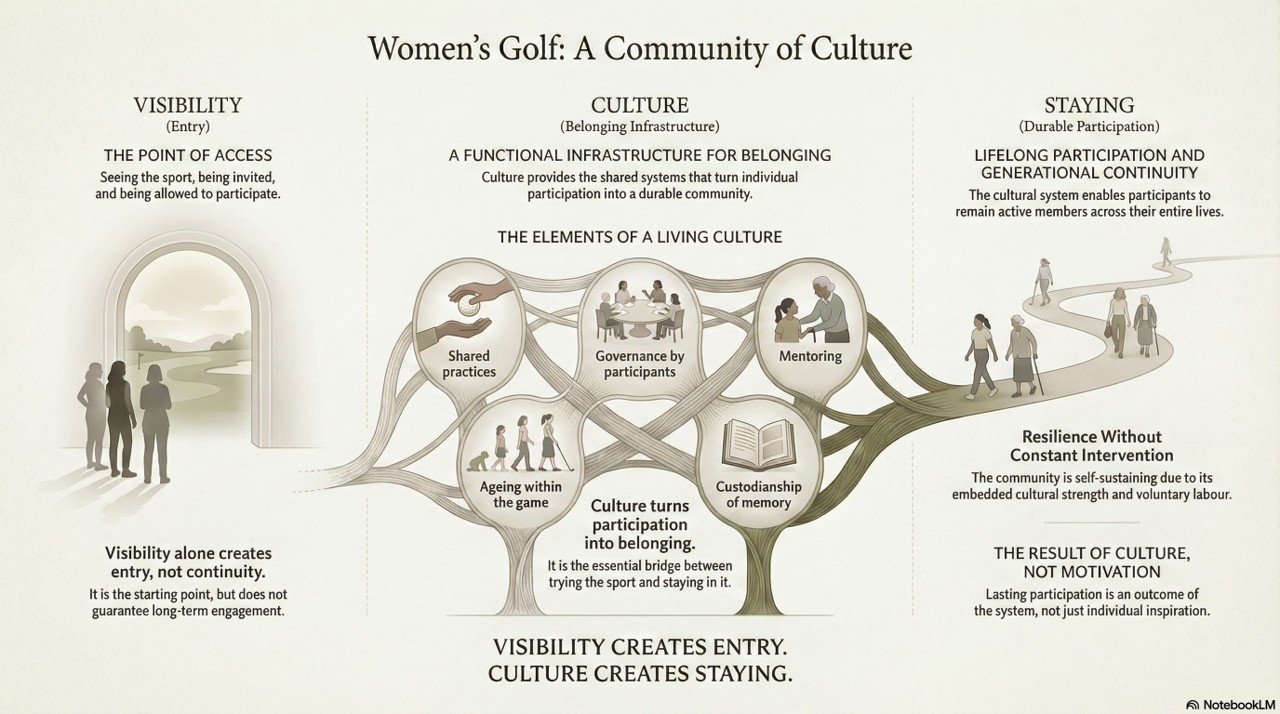
From the late nineteenth century onward, women did not simply play golf. They formed clubs, organised competitions, governed themselves, travelled to play one another, and sustained participation across decades. This was not sport delivery. It was cultural formation.
Participation before permission
Like many cultural communities, women’s golf did not wait to be authorised.
Women organised first. Formal recognition followed later, including the creation of national governing bodies such as the Ladies’ Golf Union.
This pattern — participation before permission — is not accidental.
It is how culture forms and stabilises.
Understanding this sequence matters, because it explains both the resilience of women’s golf and why it has often been misread by modern sporting systems.
Culture as infrastructure for belonging
Culture is often treated as atmosphere or tradition.
In women’s golf, it functioned as infrastructure.
Culture provided:
-
shared standards and routines
-
informal mentoring and guidance
-
governance rooted in participation
-
continuity across ageing and life stages
Where culture was present, participation became durable rather than episodic.
Where entry existed without culture, participation proved fragile — however visible or inspiring the moment of arrival.
Senior women as continuity structures
Senior women in women’s golf are often mislabelled as “retirement groups”.
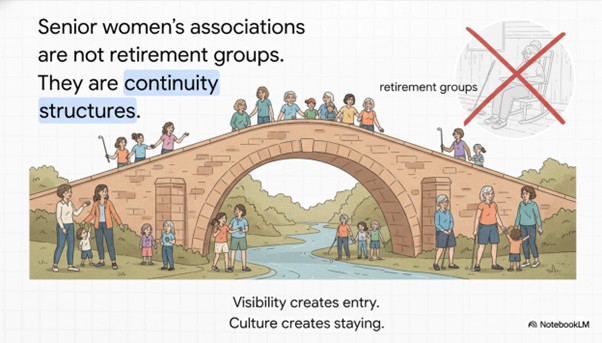
Senior women’s associations function as continuity structures. They sustain competitions, hold memory, mentor others, and maintain social and organisational bonds when formal pathways fall away.
In cultural terms, they are not legacy participants.
They are infrastructure.
This continuity has allowed women’s golf to absorb ageing rather than exclude it — a defining characteristic of a living culture.
What history makes clear
What this history makes clear is that women’s golf did not endure because women were merely allowed to play, nor because elite role models became visible.
It endured because women built and sustained a cultural world around the game — one that provided identity, continuity, authority, and a place to belong across a lifetime.
Where women organised competitions, governed themselves, mentored one another, and aged visibly within the sport, participation became durable rather than episodic.
Contemporary participation data now shows the same pattern in reverse: entry without belonging leads to attrition, however visible the moment of arrival.
This is not a lesson about nostalgia.
It is a lesson about structure and culture working together.
Why this matters now
Viewing women’s golf as a community of culture changes how we understand:
-
participation loss
-
ageing in sport
-
governance decisions
-
the role of senior women
-
what “modernisation” actually removes
It reframes women’s golf not as fragile or declining, but as culturally resilient — when its infrastructure is recognised rather than erased.
A simple principle
Visibility creates entry.
Culture creates staying.
This page forms part of the Women’s Golf History Project’s exploration of Inner Life & Culture — examining how belonging, continuity, and lived practice have sustained women’s participation across generations.